What's the Best Photo Mechanic Alternative in 2026?

Elli Kim Content
Tuesday, July 28, 2026
Photo Mechanic isn't free: Camera Bits charges $14.99 a month, $149 a year, or $299 one time for the standard edition. If you want a free alternative, Adobe Bridge covers basic browsing, rating and metadata. If your real bottleneck is judging hundreds of near-identical burst frames, a dedicated culling tool like Narrative or Aftershoot groups those frames and flags focus and eyes for you, which Photo Mechanic doesn't do.
Last updated November 12, 2026. Prices checked on each company's own site on that date.
It's 11:40 p.m. The headliner's set ended an hour ago, you shot 900 frames in three songs, and the festival wants photos by morning. Photo Mechanic gets those frames onto your screen fast. Speed at ingest isn't the problem. The problem is the 20 near-identical frames from every two-second moment, each one still waiting for you to judge it.
In this article:
Is Photo Mechanic Free?
How Long Does Event Culling Take With and Without AI?
Dedicated Culling Tools
Classic Viewers and Editors
Which Should You Choose?
Related Questions
Is Photo Mechanic Free?
No. Photo Mechanic is sold as a subscription or a one-time license:
Edition | Monthly | Yearly | One-time (perpetual) |
|---|---|---|---|
Photo Mechanic | $14.99 | $149 | $299 |
Photo Mechanic Plus (adds catalogs) | $24.99 | $249 | $399 |
A perpetual license includes one year of updates. After that it keeps working on your last compatible operating system, without new updates. Source: Camera Bits, Photo Mechanic pricing, checked November 12, 2026.
How Long Does Event Culling Take With and Without AI?
Concert and festival photographer Christina Demertzi culls 800 to 1,000 burst frames per show down to 100 to 150 selects. By hand, that took her one to two hours. With Narrative's Scenes View grouping each burst and the Close-ups Panel showing every face, it takes about 30 minutes. She still picks every final frame (full breakdown).
Photo Mechanic makes browsing faster, but it doesn't group a burst into one moment or check faces, so each near-duplicate is still its own decision.
Dedicated Culling Tools
These tools don't just help you flip through images faster. They flag focus issues, closed eyes, and duplicate scenes so you're choosing between your best shots instead of hunting for them frame by frame.
1. Narrative
Narrative is built for photographer-led culling. Its AI groups, flags and ranks your frames, and you make every call, so you keep creative control over the set.
Features:
3-second RAW import, so you can start while the card is still copying
Scenes View turns each burst into one ranked Scene
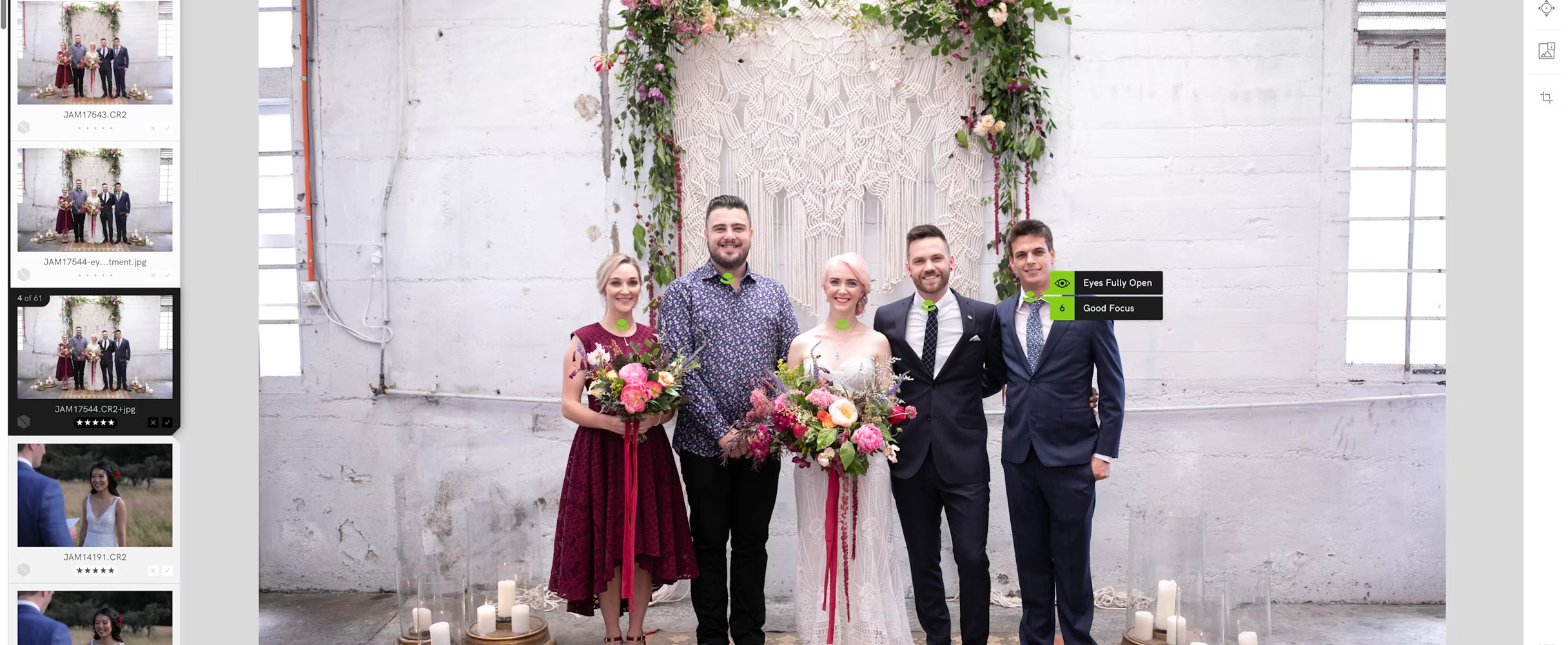
Face Assessments and the Close-ups Panel check eyes, expression and focus on every main face. At pit distance, faces are small, and Close-ups enlarges them beside the frame.
AI First Pass sorts each Scene into five categories, from Best in scene to Undesirable, with Ruthless, Balanced or Cautious settings
People Filter isolates one band member across a shoot (Mac for now)
Offline processing, so a dead zone or a flight home doesn't put your workflow on hold
Ship to Lightroom with your star ratings and color labels intact, plus Photoshop and Capture One on Mac
Pricing: Lite $10 a month and Standard, which adds Scenes and Close-ups, $20 a month, billed yearly. Premium ($40) and Ultra ($60) add Personal AI Presets. Full breakdown on the pricing page.
2. Aftershoot
Aftershoot offers two culling modes: AI-automated, which makes a first pass for you to review, and AI-assisted, where you decide every frame. It groups duplicates, flags blur, closed eyes and blown exposures, and can cull to a target number of photos. It runs locally on Mac and Windows and works offline. It also offers editing, retouching and client galleries.
Pricing: Select (culling) $10 a month billed yearly, or $45 a month billed yearly for culling, editing and retouching together. Source: our Aftershoot vs Narrative comparison, November 2026.
Classic Viewers and Editors
These remain solid, well-established options if you want something simpler, want to stay inside one app, or aren't ready for a dedicated culling tool.
3. ACDSee Photo Studio Ultimate
Formerly known simply as ACDSee Ultimate, ACDSee Photo Studio Ultimate handles culling, cataloging, and photo editing in one application, with customizable keyboard shortcuts to speed up review. It's sold as a yearly subscription or a perpetual license; check ACDSee's site for current prices.
4. Adobe Lightroom Classic
Lightroom Classic now includes Assisted Culling. It selects photos by subject focus, eye focus and open eyes, rejects exposure problems, misfires and documents, and stacks similar shots by time and visual similarity. It can run at import (Adobe help, updated June 18, 2026). If you already pay for Lightroom and don't want another app, try it first. For step-by-step settings, see how to cull photos in Lightroom.
5. Adobe Bridge
If you want to stay entirely inside Adobe's ecosystem without paying for anything extra, Adobe Bridge is the free option: a straightforward digital asset manager with no Creative Cloud subscription required, just a free Adobe ID. Features include keyword tagging, metadata editing, batch orientation adjustments, star ratings, and file organization for large shoots.
Pricing: Free, but some advanced tools, such as processing RAW images, need a paid subscription.
Which Should You Choose?
You shoot events or concerts and the burst pile is the bottleneck: start with Narrative's free trial of Ultra, no credit card needed.
You want software to make the first pass for you: Aftershoot's AI-automated mode.
You want to stay in one Adobe app: try Lightroom Classic's Assisted Culling.
You want free: Adobe Bridge.
You want fast manual culling and deep metadata, and you're happy to pay for it: Photo Mechanic is still the standard.
For head-to-heads, see Photo Mechanic vs Narrative and the best photo culling software guide.
・・・
Related Questions
What is a free alternative to Photo Mechanic? Adobe Bridge is free and handles basic tagging and organization, though it doesn't include AI-assisted culling. Most AI culling tools, including Narrative, offer a free trial so you can test the workflow before subscribing.
Is Photo Mechanic better than ACDSee? Photo Mechanic is faster for pure ingest and tagging. ACDSee Photo Studio Ultimate adds cataloging and full photo editing in one app, but like Photo Mechanic, it doesn't include AI-assisted culling.
Is Photo Mechanic better than Lightroom? Photo Mechanic is built for speed at ingest and triage. Lightroom is built for organizing and editing, and now includes Assisted Culling (focus, eyes-open and exposure checks, plus Auto Stack). Many photographers use Photo Mechanic, or an AI culling tool, for the first pass, then Lightroom for the edit.
Does Photo Mechanic have AI culling features? Camera Bits describes Photo Mechanic as a tool to ingest, cull, rate and organize, and doesn't list AI assessment of focus, closed eyes or duplicate scenes. That gap is what the dedicated culling tools on this list fill.
💜 Get the next festival set culled before the coffee's cold. Start a free trial of Ultra, no credit card needed. Already signed up? Launch Narrative.
Content