Light and Shadow: A Portrait Photographer's Guide to Dramatic Lighting Techniques

Wednesday, April 22, 2026
A technically sharp portrait isn't always a compelling one. Usually, the difference lies in the lighting—not in how much light you have, but in how deliberately you use it.
The foundation of dramatic portraiture is built on three techniques: Split, Rembrandt, and Short lighting. Whether the goal is stark intensity or painterly dimension, these styles all share a common logic: in dramatic photography, the shadow is just as important as the light.
Once you master these techniques, you move beyond mere documentation. You gain a toolkit that uses shadow and direction as primary tools to create images with genuine weight, mood, and emotional impact.
Table of contents
Split Lighting
Rembrandt Lighting
Short Lighting
Choosing Your Approach
Putting It Together
1. Split Lighting: Intense, dualistic mystery
Split lighting places your light source at 90 degrees to the side of your subject. One half of the face fully lit, the other in shadow. The result is a clear division down the center of the face.
The mood: Intensity, power, mystery. It's the most dramatic pattern on this list.
The setup: Position your light at eye level, directly to one side. Look for the shadow line to bisect the face cleanly down the nose bridge. A reflector on the shadow side can lift detail if the contrast reads too stark.
Best for: Editorial portraits, individual sessions where the brief calls for edge and presence.
It's worth noting that split lighting accentuates facial texture, including the texture of the skin, beard, and bone structure. Depending on the subject, this can be an asset or a liability, so it's best to read your subject before committing.

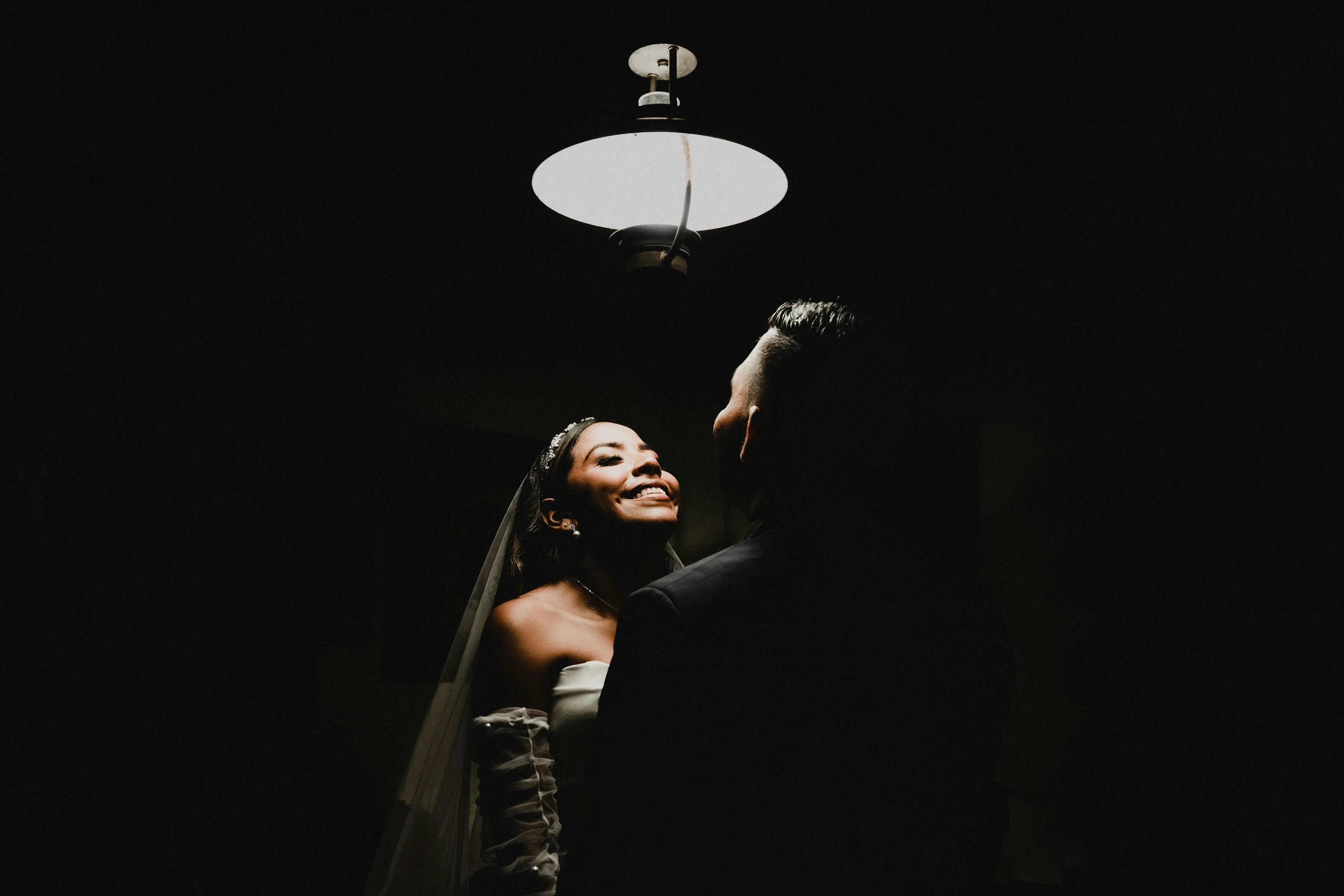
This wedding portrait by Rebeka Lucija Studio is a stylish example of split lighting used to create instant impact. With the light hitting from camera-left at nearly 90 degrees, the face is bisected by a clean, vertical shadow line.
Why it works:
High-Contrast Impact:
The stark white jacket against the dark background amplifies the "edge" of the shot, pushing the dramatic mood even further.Layered Composition:
While the foreground subject carries the drama, the more softly lit subject in the background provides essential depth without distracting from the main split-lighting pattern.The Result:
This setup demonstrates how split lighting can transform a simple, centered pose into a powerful statement of presence and weight.
・・・
2. Rembrandt Lighting: Timeless, artistic depth
Named after the Dutch master whose painted portraits defined the technique, Rembrandt lighting positions the light at roughly 45 degrees to the subject and slightly above eye level. The signature is a small triangle of light on the shadowed cheek, created when the shadow of the nose reaches out to meet the shadow of the side of the face, trapping a patch of light between them.
The mood: Classic, painterly, dimensional. Less confrontational than split lighting, but still rich with depth.
The setup: Move your light from the 90-degree split position toward the camera until that distinct triangle appears on the shadow cheek. A more focused light source gives you cleaner triangle definition than a large softbox.
Best for: Character portraits, subjects with strong facial structure, any session where you want gravitas without full drama.
The triangle can quickly disappear when you adjust the angle or position of the subject. Lock your light and move your subject incrementally.

This bridal portrait by Sampark Films demonstrates how to find "painterly" light in a real-world setting. A single directional source from camera-left strikes the face at a 45-degree angle, pushing the far side of the face into a moody, near-total shadow.
Why it works:
The Signature Triangle:
Look closely at the shadowed cheek. The light catching the skin's surface marks the beginning of a classic Rembrandt triangle, adding instant gravitas to the shot.Natural Highlights:
The high contrast ratio allows the jewelry to catch the light against the darkness, providing depth and "sparkle" without the need for a secondary fill light.Studio Quality, Anywhere:
This is proof that the Rembrandt technique isn't confined to a flash setup, and a way of seeing light that translates perfectly to available-light environments.
・・・
3. Short Lighting: Sculpted, dramatic narrowing
Short lighting is achieved by positioning the light on the far side of the subject's face — the side turned away from the camera. This means the larger portion of the face visible to the lens falls into shadow, with only the narrow, far side illuminated.
The mood: Moody, cinematic, mysterious. It produces more shadow across the face than any pattern except split, giving portraits a strong sense of depth and weight.
The setup: Have your subject turn slightly away from the camera. A three-quarter pose works well. Place your light on the far side of their face, so it illuminates the side the camera sees least. The shadow will fall across the broader visible plane of the face naturally.
Best for: Moody individual portraits, dramatic couples shots, any session where you want dimension and shadow to dominate. It also has a slimming effect on broader face shapes, which makes it a useful tool when reading your subject.
Short lighting requires the subject to turn away from the camera, which can make the image feel less engaging if the pose isn't right. Strong eye contact toward the lens, even from a turned position, prevents the image from appearing closed off.
Also it's worth noting that short lighting isn't a pattern — rather, it’s a direction that can be applied to Rembrandt or Split lighting. Its direct counterpart is broad lighting: the same pose, with the light moved to the near side of the face. Where short lighting narrows and shadows, broad lighting opens and widens. For subjects where short lighting reads as too intense, broad is the natural adjustment.


These two frames by Kristen England Photography show how subject positioning alone determines whether you're using short or broad lighting — same window, same light, opposite results.
In the first frame, the subject turns toward the light, illuminating the broad, near side of her face. In the second frame, she turns away — the camera-facing side falls into shadow, the narrow far side catches the light. That's the entire difference between the two techniques.
Why it works:
Mood Follows Direction:
The broad-lit frame feels open and warm. The short-lit frame is quieter and more inward. The emotional shift between the two is created entirely by light direction.
One Light, Two Techniques:
The window never moves. What changes is the subject's relationship to it — demonstrating that short and broad lighting are decisions made with posing, not equipment.
Real Light, Real Results:
The curtain casts pattern, the light is warm and imprecise. Neither frame is studio-perfect, and that's the point. The best portrait photographers don't chase the diagram — they chase the moment, and use whatever light is available to serve it.
・・・
Choosing Your Approach
These three patterns exist on a spectrum from most to least intense, but they all use directional light and shadow as their primary tools.
Split is the most extreme. The light divides the face equally in two, leaving no ambiguity. It's the pattern to reach for when the brief demands maximum edge and presence.
Short puts the majority of the visible face in shadow by lighting the far, narrow side. Slightly less confrontational than split, but still heavy with mood and depth. Its counterpart, broad lighting, uses the same pose with the light on the near side — producing a warmer, more open result when short reads as too intense.
Rembrandt is the most nuanced of the three. The 45-degree position and the characteristic triangle of light on the shadow cheek produce drama that feels painterly rather than stark. Gravitas over intensity.
The practical question isn't which pattern is best, but which serves the subject and the brief. A strong bone structure and a moody brief points toward split or short. A character portrait that needs depth without confrontation points toward Rembrandt. A subject where short feels too severe points toward broad. Start with the mood you're after, choose accordingly, and adjust from there.

Image by The Captured Moments Co
・・・
Putting It Together
These lighting patterns and directions are reference points, not rigid recipes.
In a controlled studio with a cooperative subject, achieving a textbook result is straightforward. Move the light, read the shadow, adjust. In the real world of portrait and wedding photography, it's messier. Natural light shifts, subjects move, and venues constrain where you can position both your subject and your source. Most working photographers approximate these patterns rather than execute them precisely, and most published portraits blend characteristics of two or three at once.
That's not a failure of technique, but how light actually works. The value in learning these patterns isn't to replicate them exactly. It's to develop a vocabulary for what you're seeing and a instinct for what to adjust when the result isn't what you intended. When a portrait feels flat, you reach for more contrast. When it feels harsh, you add fill or move the light forward. When it feels generic, you push toward split or short. The pattern names give you a framework; the shoot gives you the reality.
The real skill is reading both simultaneously. Knowing what you're aiming for, recognizing when you're close, and making the adjustment before the moment passes.

Image by Rebeka Lucija Studio
Once you've made those decisions and fired the shots, the next challenge is finding the frames where everything actually landed — light, expression, focus — across hundreds of near-identical images.
Try Narrative for free and cull a full portrait session in minutes, not hours. Narrative instantly assesses and rank sharpness, expressions, and open eyes, making it the most streamlined post-production tool for photographers shooting at high volume.
Cover Photo by Hugo Martínez