How Many Photos Should a Wedding Photographer Deliver?

Elli Kim Content
Monday, June 29, 2026
The straight answer is 50 to 75 edited photos per hour of coverage. For an 8-hour wedding, that's 400 to 600 images. For a 2-hour ceremony-only booking, 100 to 150.
These numbers reflect what's actually possible when you shoot professionally, cull honestly, and edit to a standard you'd put in a portfolio. Below is where that range comes from, why it varies, and what happens to client relationships when you drift too far in either direction.
In This Article
Where the Benchmark Comes From
Why the Number Varies
The Cost of Delivering Too Many Photos
How Culling Determines Your Delivery Count
By Coverage Length: What to Aim For
Setting Client Expectations Before the Wedding
FAQs
The Number That Actually Matters
Where the Benchmark Comes From
Most professional wedding photographers capture somewhere between 2,000 and 3,500 frames on a full shooting day. Two photographers in the mix pushes that toward 4,000 or higher. A single photographer covering a short ceremony might shoot 500.
From those raw captures, the typical delivery ratio runs about 3:1 to 4:1. Shoot 3,000, deliver 750 to 1,000. Shoot 600, deliver 150 to 200.
That ratio is an outcome, and not a rule. It's what happens when you remove the technically broken shots (soft focus, eyes closed, motion blur), thin out the near-identical frames from burst sequences, and then make the harder call: does this image add something, or does it just fill space?
That last pass is where most photographers underperform. Removing the obvious duds is time-consuming, but manageable. Removing a photo that's perfectly fine but not quite as strong as the one next to it? It's harder, and if you skip it, you end up with a weak gallery.
Why the Number Varies
Coverage length is the biggest variable, but it isn't the only one.
Hours of coverage sets the ceiling. There are only so many distinct moments in a wedding day, and more coverage time gives you more of them. A 4-hour booking might include the ceremony, family formals, and portraits. A 12-hour day adds getting ready, cocktail hour, reception speeches, and dancing. More moments, more deliverable images.
One photographer vs. two changes the math significantly. A second photographer captures parallel moments that a single shooter has to choose between. Two photographers at a 200-guest reception will legitimately produce a larger final gallery than one photographer at the same wedding.
Wedding size affects volume. A 20-person elopement has fewer distinct people, fewer group combinations, and fewer scenes than a 250-person traditional wedding. The gallery reflects that.
Shooting style matters too. A photojournalistic photographer working in continuous bursts will shoot more frames and cull more aggressively. A more composed shooter who fires less often will have a higher keeper rate and a smaller initial take.
None of these justify delivering 1,500 images from an 8-hour wedding. They explain why 600 might be the right number for one couple and 450 the right number for another.
The Cost of Delivering Too Many Photos
Early in your career, the impulse to over-deliver makes sense. More photos feels like more value. It tends to backfire.
When a client opens a gallery of 1,200 images, they start looking for patterns. They find five nearly identical shots of the first dance and wonder why you kept all five. They find a frame where someone's eyes are slightly closed. They find a photo of the catering staff that has nothing to do with their day. These are the frames that generate complaints. They get noticed precisely because the sheer volume invites scrutiny.
A gallery of 550 strong, well-curated images tells a different story. Every frame justifies its place. The client doesn't question what was left out because there's nothing in the gallery to raise the question.
Quantity doesn't protect you from complaints. A well-curated gallery does, and that curation happens during culling.
How Culling Determines Your Delivery Count
Photographers over-deliver because they don't have a proper culling system. Manually reviewing 3,000 frames, checking expressions in group shots and focus on fast-moving subjects, can consume 5 to 7 hours. When culling is that slow, the temptation is to lower the bar: keep the borderline shots, skip the second pass, deliver 900 instead of 600.
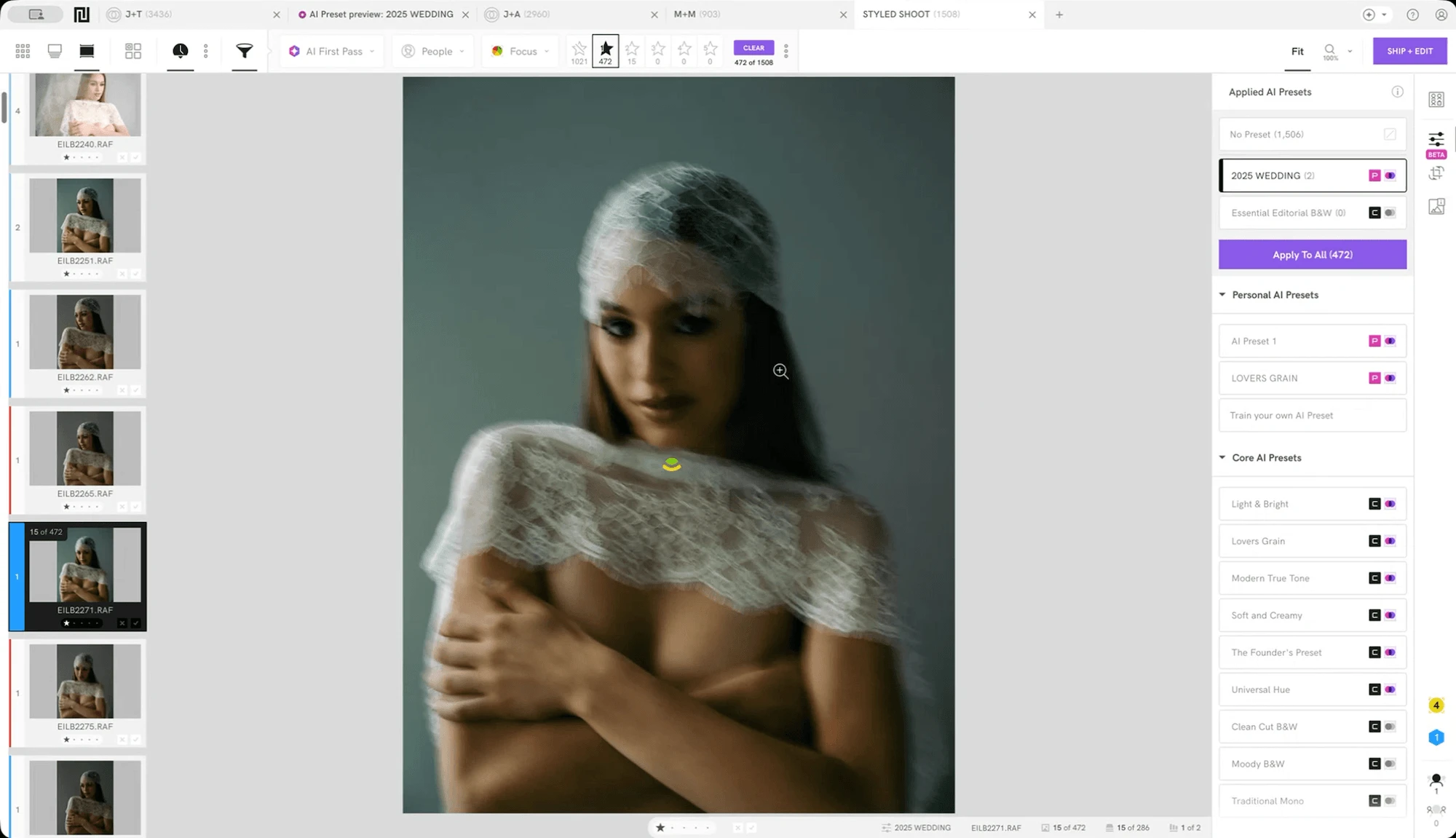
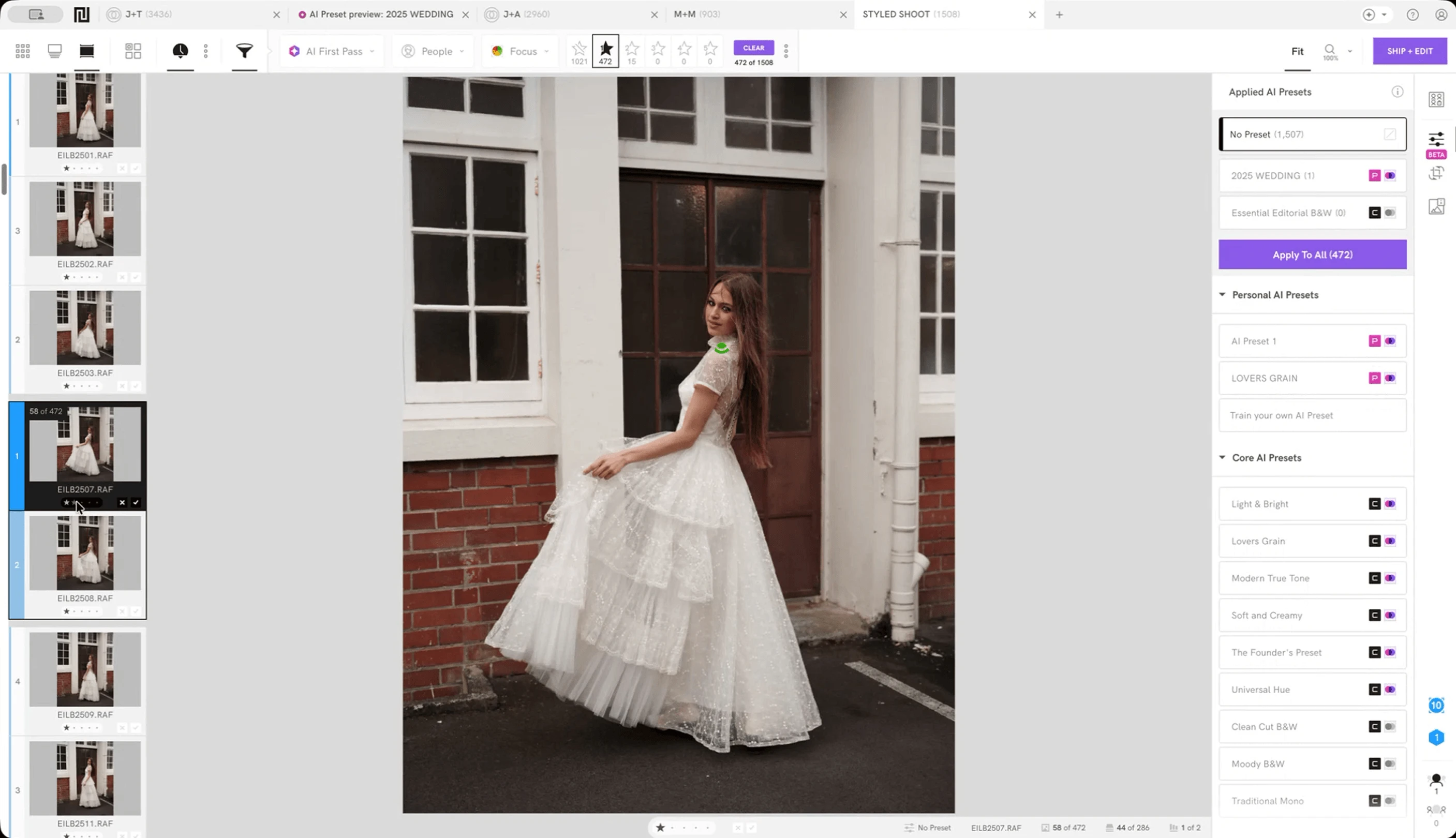
This is why photographers who deliver consistent, well-curated galleries use dedicated culling software like Narrative. A culling tool will pre-sort images by technical quality and automatically flag focus issues, closed eyes, and expression problems before you start reviewing. Your final gallery is tighter and more thoughtful because you make subjective decisions after the mechanical work is finished.
By Coverage Length: What to Aim For
Use these as starting points, not contracts. Your shooting style, the size of the wedding, and whether you're working with a second shooter will all move these numbers.
Coverage length | Frames captured (approx.) | Recommended delivery range |
2–3 hours (ceremony only) | 400–700 | 100–200 |
4–6 hours (partial day) | 900–1,500 | 250–450 |
8 hours (full day, 1 photographer) | 2,000–3,000 | 400–650 |
10–12 hours (full day, 2 photographers) | 3,500–5,000 | 600–900 |
If you're consistently delivering above the top of these ranges, it's worth asking whether you're skipping the second cull pass rather than genuinely capturing that many strong images.
Setting Client Expectations Before the Wedding
The number in your contract should be a minimum, not a target.
"At least 400 edited images from 8 hours of coverage" sets a clear expectation without locking you into an arbitrary count that doesn't account for how the day actually unfolds. It also removes the temptation to pad the gallery just to hit a number.
One option worth considering: in your pre-wedding consultation, briefly explain that you cull before you edit. Telling them you review every frame to deliver the strongest possible gallery positions curation as part of the service, not a constraint on what they receive. It also heads off the post-delivery request to "send everything." Once a client understands you actively removed technically weak and redundant frames, they trust the selection rather than wonder what's missing.
FAQs
How many photos is too many for a wedding gallery?
Galleries above 800 images from a standard 8-hour wedding start to feel overwhelming for most clients. The problem isn't the number, but keeping borderline shots in the finally gallery to pad it. Aim for galleries where every image earns its place.
Should I put a specific number of photos in my contract?
Specify a minimum, not an exact count. "At least 400 edited images from 8 hours of coverage" protects the client and sets professional expectations without locking you into an arbitrary target.
Factor in the scale of the wedding too. A 20-person elopement and a 200-guest reception will naturally yield very different galleries, even with the same hours of coverage.
Do clients own the photos I don't deliver?
No. Outtakes and rejects are part of your professional workflow, not deliverables. Your photography contract should state that you retain and may delete images not included in the final gallery. Most clients don't want the rejects. They want confidence that what they received is your best work.
What if a client asks for the RAW files?
RAW files are working files, not deliverables. Most professional photography contracts explicitly exclude them, and you're under no obligation to hand them over.
A useful way to explain it: a client hiring a graphic designer doesn't receive the layered source files unless they've specifically paid for them. Your edited JPEGs are the finished product. If a client pushes on this, it's worth revisiting your contract language to make sure RAW files are clearly excluded.
See how to handle RAW file requests for a full breakdown.
Does delivering more photos help avoid complaints?
Generally no, and it can make things worse. A well-curated gallery of 500 strong images generates fewer complaints than an uncurated gallery of 900. Quantity invites scrutiny. Clients notice the weak frames precisely because there are so many frames to notice.
How do I cull faster without lowering my standards?
Photo culling tools like Narrative pre-sort the entire shoot by technical quality, flagging focus issues, closed eyes, and expression problems before your manual review. This compresses the mechanical part of culling so you spend your time on the subjective calls that actually shape the gallery.
The Number That Actually Matters
The right number of photos isn't one that impresses clients with volume. It's one that holds up when they look at the gallery a year later, five years later, on the day their kid asks to see the photos from their parents' wedding.
That gallery is built during culling, not during shooting. The photographers who get it right are the ones who take the cull as seriously as the edit, and who have a workflow fast enough to do it properly.
💜 Ready to cut your culling time without cutting your standards? Start Narrative free on Ultra Plan. No credit card required, no strings attached.
👀 Check out how one pro culls 11,000+ images to a final gallery.
Related reading:
_
Cover Photo by @marilyn.joy_photography and @thebohobungalow_.
Content