How Eilish Burt Plans a Styled Shoot Without a Mood Board

CREW The Narrative Newsletter
Wednesday, October 7, 2026
You want to shoot weddings, but couples book from a portfolio, and you don't have the wedding work to show yet. A styled shoot is how a lot of photographers solve that. It's a shoot you organize yourself, with vendors and models you choose, so you can make the work you want to be hired for without a client's timeline. Wedding photographer Eilish Burt plans hers with three things: Instagram DMs, a timesheet, and a one-line brief instead of a mood board.
Eilish has run Eilish Burt Photography in the Bay of Plenty, Aotearoa New Zealand, since 2017. In a live Narrative webinar, she walked through a recent styled shoot in central Auckland, from the first message to the final cull. Here's how she put it together.
Why do a styled shoot at all?

For Eilish, a styled shoot does two jobs. The first is creative. "It was just for me to be able to fully be creative and not be pressured with a photo timeline," she says. On a wedding day, every portrait session is squeezed between the ceremony, the speeches and the light. On a styled shoot, the time is yours.
The second job is relationships. "Styled shoots are an amazing way of networking with your industry," she says. "If you're wanting to step into the wedding industry and be a wedding photographer, an amazing way of beginning that networking process is going through doing a styled shoot and getting to know the different vendors."
That's the part newer photographers tend to underrate. The boutique, the gown maker and the makeup artist on your styled shoot are the same people who work weddings every weekend, and they refer photographers they've worked with. For more on building those relationships, see Narrative's beginner's guide to networking for photographers.
Step 1: Build your team through DMs
Eilish didn't send a formal pitch. She sent Instagram messages.
For this shoot, she messaged Lizzie Langridge, owner of the Auckland vintage bridal salon Love James, who she already had a relationship with. She did the same with New Zealand bridal designer Harriett Falvey, who makes her own custom pieces. Makeup artist Ruth, of Made Up By Ruth, came to her: she had already reached out to say she'd love to work together on a styled shoot.
"Using social media as a way of networking, you cannot go wrong," Eilish says. "Don't be afraid to DM your favorite vendors and just have a yarn. Don't be a stranger, because it's a great way of getting your foot in the door with these amazing, talented creatives in the industry."
Her advice is to start with people you'd like to work with again. "People who I wanted to work with," she says of this team. A styled shoot is a first collaboration, so choose vendors whose work you'd be proud to be associated with on a real wedding day.
Step 2: Send everyone a timesheet
Once the vendors said yes, Eilish's main planning document was a schedule. "I put together a finalized time sheet so they could see where they were expected to be and at what time," she says.
It's a small thing that makes you look like a professional to people who have never worked with you before. Vendors are giving you their time, often on a day they could be booked. Telling them exactly when and where they're needed respects that.
Step 3: Pick a base, not a route
Eilish wanted an urban look, shot out on the street. Instead of planning a series of locations, she booked an Airbnb on Queen Street, in central Auckland, and the team shot everything within a 10-minute walk of it.
A base solves several problems at once. Hair and makeup have somewhere to set up, models have somewhere to change between looks, and you have an indoor option if the light or weather turns. As it happened, the Airbnb also gave her one of the best setups of the day (more on that below).
Step 4: Swap the mood board for a one-line brief
When the vendors asked to see her mood board, Eilish didn't have one. "I'm quite bad in this sense," she says. "I was just like, I know what I want when I see it."
She did look on Pinterest for inspiration. "There was nothing really that captured my eye," she says. So instead, she gave the team a brief: "I want this to be full-blown creative freedom. I don't want to tie you guys down to a certain box. I just want you to do what feels right." Her reasoning: "Different is what captures people's eyes at the end of the day."
This won't suit everyone. A mood board is a fast way to get a team on the same page, and the vendors asking for one is a sign that many of them expect it. But if you already know your style and you've picked collaborators whose work you trust, a clear brief can leave more room for everyone's best ideas. If you're still working out what your look is, start with how to find your wedding photography style first.
Step 5: Shoot headshots before hair and makeup
Before the models went into hair and makeup, Eilish photographed a set of simple headshots for their modeling agency. When she chose between them later, she picked the frames where the model looked straight into the lens. "She's looking right down the barrel," she says. "I think these ones are a bit more captivating for people who might be looking into her to use for their campaign."

It's an easy way to give something back to the people working with you for free or for exposure. The models leave with portraits their agency can use, and the makeup artist gets her own selects too. Everyone on a styled shoot should come away with images they can share.
Step 6: Match the light to each look, on the spot
Not every look worked in the same setup. One model's makeup was light and ethereal, and the soft, airy setup suited her. The second model's makeup was grungier, and the same setup fell flat. "This background, this lighting just wasn't hitting with her look," Eilish says. "So I had to change something."
She looked around the Airbnb and saw minimal light coming through a single window, with a dark blind behind it. "I just said, could you stand there for me for a second? I can see something there," she says. The blind worked as a black backdrop, and the single window gave her one source of light against it.
Then she slowed her shutter so movement turned into soft blur, a technique she calls shutter drag. "I knew it would look really good in post-production with my edit on top," she says. "It's a lot more grungy."

The lesson for your own shoots: when a setup isn't working for a look, change the setup, not the person. Even small changes count. On one headshot, Eilish rejected a frame because the light missed the model's face, and kept the next one, where "it's literally just a subtle change of moving her face toward the light a bit more."
Step 7: Read the light on the day
Eilish takes the same approach to her weddings. She never scouts a venue in advance, because the light on a scouting visit is rarely the light she'll have for portraits. "I genuinely am just led by feeling," she says.
She knows that sounds risky. "It might be controversial for some people, but for me, that's what works," she says. "You can plan and plan and plan, but then the wedding day is never going to be what you planned it to be." A styled shoot is a low-stakes place to practice thinking on your feet, which is exactly the skill a wedding day tests.
After the shoot: from 1,500 frames to a gallery
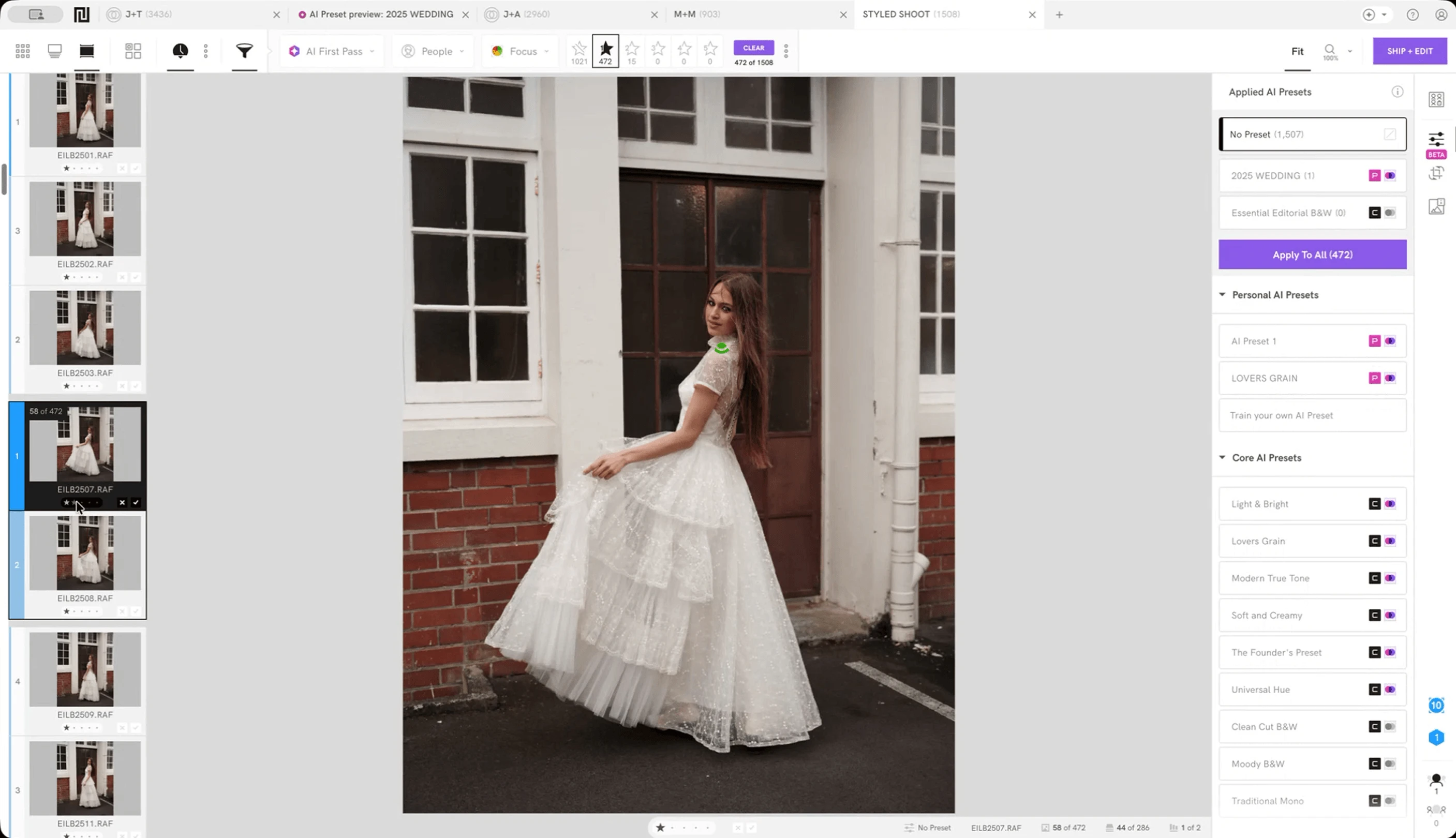
Eilish came home from this shoot with about 1,500 photos. She culled them in Narrative in two passes: a first pass giving one star to every frame worth a second look, which left 488, then a second pass where only the strongest got two stars and went on to Lightroom.
Her full cull, including why she often keeps the out-of-focus frames, is in why wedding photographer Eilish Burt keeps the blurry frames.
The details to sort out before shoot day
Eilish's walkthrough focused on the creative side. A few practical questions come up on every styled shoot, and they're easier to settle in the first DM than after the images are out.
How many looks, and how much time. Eilish worked with at least two models, each with a different makeup look, plus a round of headshots before hair and makeup. Plan your looks first, then ask your makeup artist how long each change takes, and build your timesheet around those changes and the light you want. A base close to every location, like Eilish's Airbnb, means less of that time goes on travel.
Who pays for what. Styled shoots are usually collaborative, often called TFP ("time for prints"), where everyone trades their time for images instead of money, as Adorama explains. That doesn't mean the shoot is free. There are still real costs, like a venue, model fees or rentals, and LegalClarity recommends writing down who covers each one. On this shoot, Eilish booked the Airbnb herself.
Who owns the images, and how everyone is credited. In New Zealand, the photographer owns copyright by default unless they are an employee or were commissioned, which means engaged and paid for the work before it was created, according to law firm Lane Neave. On a styled shoot you organize yourself, that usually means you. If a vendor is paying you to shoot, ownership can change, so agree on it in writing first. Either way, spell out how vendors can use the images (their website, social media, ads) and how everyone gets tagged and credited. Narrative's photography copyright guide covers the basics. This isn't legal advice, so check with a lawyer if you're unsure.
Model releases. If the images might be used to promote a business, get signed model release forms from every recognizable person before you start shooting, not after.
Permits for shooting on the street. Rules depend on your city. In Auckland, Screen Auckland requires a permit for "filming activities in Auckland public open spaces such as footpaths, roads, parks, beaches," and needs five full working days to process an application. Its permit page doesn't say whether a small stills crew counts, and it invites you to get in touch if you aren't sure. Elsewhere, check with your local council before you plan street locations.
Getting the shoot published. If you want the shoot featured, decide that before anyone posts. Publications set their own rules. Atlanta Style Weddings, for example, asks that print submissions go to only one publication at a time and wants a full list of every vendor involved. A simple fix is to name one person to handle submissions and ask the rest of the team to hold off posting until you hear back. For more, see how to get your wedding photography featured.
💜 Try her look: Eilish created Lovers Grain, an AI Preset for Unscripted and Narrative with "warm, sun-kissed tones and soft vintage grain." It's free on the Standard plan and above.
📸 Try it yourself: Narrative offers a free trial, no credit card required, on the Ultra plan, so you can cull your own styled shoot the same way. Start your free trial.
👀 Watch the full conversation: This article is drawn from a live Narrative webinar with Eilish Burt. Watch the full webinar on YouTube.
About the webinar guest: Eilish Burt is a wedding and portrait photographer based in the Bay of Plenty, Aotearoa New Zealand, shooting in a vintage, film-inspired documentary style. She has run Eilish Burt Photography since 2017 and is a guest speaker at events. Find her on Instagram @eilishburtphotography or at eilishburtphotography.com.
The Narrative Newsletter